Leaderboard
-
17D_guy
Supreme User7Points1,887Posts -
drewpey
Supreme User7Points629Posts -
Sua Sponte
Supreme User6Points1,806Posts -
jazzdude
Supreme User6Points1,151Posts



Popular Content
Showing content with the highest reputation on 11/07/2020 in Posts
-
7 pointsExhibit 1 on why we will never get away from hours and hours of annual SAPR training. Yikes thats a hot take. Also who raised you that preferring to be a gentleman with couth was a sign of a feminine man?7 points
-
5 pointsI never said anything about racism...wtf are you on about? Just to be clear when you talk about the before part and "out of context" you must have just forget this part - "I’ve gotta use some tic tacs, just in case I start kissing her. You know I’m automatically attracted to beautiful—I just start kissing them. It’s like a magnet. Just kiss. I don’t even wait. And when you’re a star they let you do it. You can do anything....Grab them by the pussy,...You can do anything” No...that doesn't sound consensual to me. Especially that "Just kiss. I don't even wait." We're talking about the ladies in our lives and why they're turned off by Trump's rhetoric. I specifically said my wife waited through to see if she agreed with his policies, some she did...most she didn't. COVID response was probably the final straw for her personally, it was for me. Over it all was a inability to stand they way he communicates anything. Again you denigrate the people who disagree with you: "feminine men." Thereby inferring only masculine dudes don't have a problem with his lack of "being a gentlemen." There are a lot of conservatives who're calling him out right now for "being an A$$" and calling our democratic institutions a fraud. A plan from Republicans that doesn't cause her family to go into bankruptcy because of issues beyond their control. gg, no re5 points
-
3 pointsQuoted for your effective research. Or maybe you choose to only see things that benefit your argument? I seem to remember a time when socialists took lists of names in history, didn't end up going very well... Wait, maybe that was the "old" history before it was re-written by the Left.3 points
-
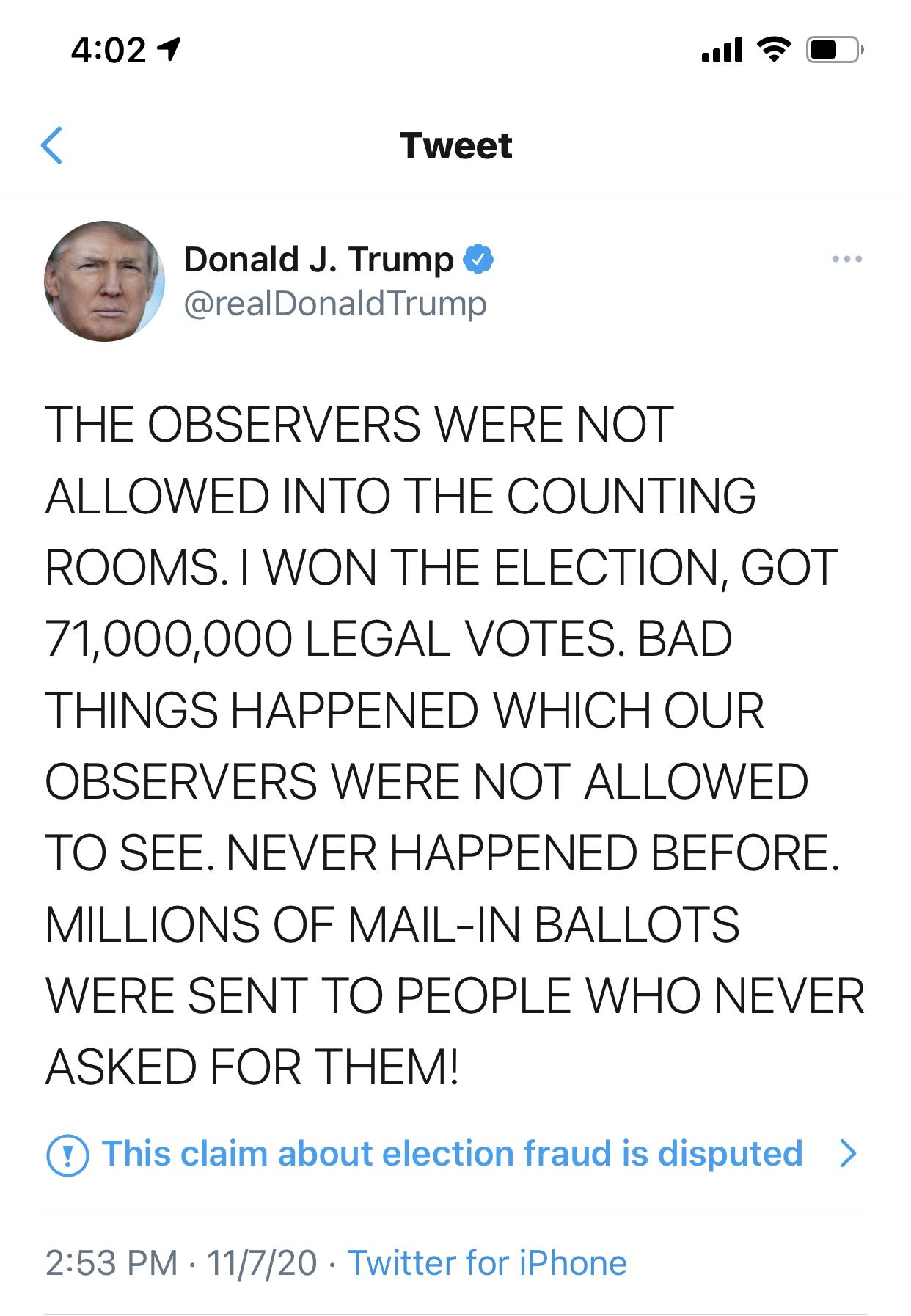
3 pointsTo be fair, no one could predict the level of shenanigans surrounding this "election"...3 points
-
3 pointsWhat if I told you that the economy is so f’ed and the national debt is so immense that the future of austerity is going to drive force structure and mission changes anyway, as all the services and our Executive/Legislative Branch leaders face the choice of destroying the country with debt (not to mention entitlements), or remaining in far flung missions around the globe? If that doesn’t get you thinking, what if I instead told you that everyone else’s economy is also as f’ed as ours was by the ‘Rona, so nobody (not even China) is any better or worse off respectfully, and everything will go on as before...? We don’t know which is true yet, but I’d offer that regardless of who wins the WH, there are massive cuts coming to the DoD - either as a second term “look how efficient I am” win, or as a matter of policy to pay for entitlements. Either way, a new force structure is coming, and not just in the service... I think the legacy of Goldwater-Nichols and the Combatant Commands are on the block too. Churchill said it first: “we are out of money, time to think...” Chuck3 points
-
3 pointsLil' Wayne and 50 Cent voted for Trump. Tupac and Nipsey Hussle voted for Biden.3 points
-
3 pointsIs it just me, or does choosing people based on race, sex, national origin, or any other immutable characteristic quite literally tokenize them?3 points
-
3 points
-
3 pointsI was really hoping for Klobuchar as the running mate. Hell, I think a Klobuchar/Buttigieg ticket would’ve been highly preferable to what we got. I really hope the lesson both parties take from this election is that America wants them to moderate. The pessimist in me says they will just double down though. The R’s have seen how a populist cult of personality can charge their base, and the D’s will likely conclude that a more progressive candidate would’ve led to the gains in congress they’d hoped for. It’s kind of depressing.3 points
-
3 points"They" didn't pick him, the democratic voters did. Elizabeth Warren and Bernie Sanders were the undisputed chosen ones of the democratic complex. So much so that analysts and commentators on both sides believed Joe Biden didn't have a chance. But when the voters got their say, they overwhelmingly rejected the socialists. The Democratic machine, to include Joe biden, completely missed that message and gave him a hardcore progressive as a running mate. It looks like he's going to be president, but it would have been no contest if he had picked another moderate running mate, like klobuchar. This all goes to show that no one in Washington has learned anything. Hopefully the Republicans are a bit more studious, because they are poised for a huge victory in 2024 if they take the lessons of trump and apply them to someone who isn't a complete lunatic. And as for Texas turning blue, I talked to a lot of republicans, particularly women, who just couldn't bring themselves to vote for Trump no matter what. My wife is one of them. Put a sane conservative on the ballot and you'll see the Texas moderates hesitant to vote for someone who wants to take away their guns and raise taxes.3 points
-
3 pointsYou guys would rather think the average Biden voter - not just Antifa and BLM - could be part of a giant conspiracy that stretches across America to falsely deny Trump the presidency than realize that mail in ballots have literally always been more blue than red. You think the government is absolutely inept and can’t accomplish anything, but at the same time you believe that 5+ states can all get away with massive, simultaneous, and complicated voter fraud on a scale that isn’t even within an order of magnitude of anything seen before. You believe this just because the president says it’s happening. Not Fox. Not AP. Not any normal news outlet, just the president. Put some more faith in your average friend that voted against Trump. The thing that’s actually messed up is that our President is trying to disenfranchise regular voters just because they are not in his favor. It’s messed up to declare victory when you have less than 220 electoral college votes on the first night and declare fake news to anything opposing this. It’s messed up to push for lawsuits to stop the counting on states you have a lead in while pushing lawsuits to continue the counting in states you’re losing. I voted by mail, as is my right in the state I’m registered in, and I intend to keep that right. Have an iota of integrity, and just take the results. One side hasn’t said anything of the sort. One side will do whatever it takes to ensure a win, even if that is destruction of faith in the literal American system that is the same as it has been for the last many decades. This election isn’t new, and the problems associated aren’t new. Remember GWB in 2000? I’m sorry that you potentially are going to lose, but we need to pull together and support the actual system of democracy.3 points
-
2 pointsNeither does a candidate. No matter how many times he types in all caps like a Boomer.
 2 points
 -
2 pointsTrump has been the only president in my lifetime who avoided starting a new conflict or invading another country. Who are we going to pick a fight with now since it's returning to "normal."2 points
-
2 pointsIn 2000, Al Gore conceded Florida on December 13th...just for a frame of reference for litigation purposes2 points
-
2 pointsCongrats to Biden. trump has no one to blame but himself. They made a huge strategic error on the first debate trying to bully Biden and portray him as weak. Made trump come off as rude. Also his tone post corona virus should have softened instead he doubled down. but more importantly when will the gambling websites pay out daddy put some nice money on a Biden victory.2 points
-
2 pointsThat a professional caught and fixed. Hell, we should hire that person to run Finance.2 points
-
2 pointsGenerally, yes. Part of the American culture is that if I work hard, I can get rewarded for that work and create more opportunities for myself. Here's a 2016 look at the Air Force demographics as a whole, broken out by rank and component. First page shows breakdown of majority/minorites vs rank, second page shows men/women vs rank, followed by a more in depth breakdown of numbers. https://diversity.defense.gov/LinkClick.aspx?fileticket=gxMVqhkaHh8%3D&portalid=51 The percentage of women tends to stay more or less constant across the ranks, so you'd infer that generally, women compete on an equal footing compared to men for promotion and retention, as the relative proportion stays pretty much the same. I'd posit based on that data that gender isn't as big of an issue for diversity, though maybe improvements could be made in the recruiting end. However, looking at racial majority vs minority, as you increase in rank, the percentage of minorities goes down. Why? Is it that minorities just can't hack the mission and thus are promoted at lower percentages than their peers? Or is there something tipping the scale against them as they promote? Maybe there something that causes then to leave the service before the next promotion? It's all correlation, and the AF and DoD are after why it's happening. Here's a long read, and I'll admit I only skimmed quickly through it, but looks like my guesses at how to attack the problem aren't too far off what DoD is planning to do: https://diversity.defense.gov/Portals/51/Documents/Special%20Feature/MLDC_Final_Report.pdf Again, I only did a quick skim, but I didn't see quotas mentioned as a solution One thing the report does call out is that higher ranks tend to come from combat specialties, which tend to have more white men compared to other specialties, and discusses trying to remove those barriers (real or perceived) to entry in the combat specialties. For the AF, this means pilots. The discussion tend to focus on the line flyer and hacking the mission, but the AF also needs to develop people to fill the staffs and to lead. And we need good people on both paths. This need creates conflict, as some just want to fly their whole careers, and some want to fly, then move onto other things while flying if they can (or not). That conflict gets more complex when you throw race/gender on top of it. Unless you want the staffs filled by support AFSCs that may not understand how we fight and how the decisions they make affect the warfighter (line pilot). But again, the answer is not quotas, as it's heavy handed and creates conflict between groups that no one wants. But if we end up with quotas, it's because of a failure of leadership and management at all levels in the service.2 points
-
2 pointsI will give you that there's probably not a lot of overt racism/sexism anymore. I don't support quotas for the long run, and I'm not sure that quotas in the near term are necessarily the right answer either (if anything it should be a tool of absolute last resort except maybe in recruiting efforts/goals, and I don't think we're anywhere near needing to be that heavy handed for promotions or retention). Hate to quote my earlier post, but going to do it anyways... Those are the kind of fixes we should be after, not necessarily mandating quotas, which would likely lead to resentment on both sides of that quota. But the military does like to promote a certain appearance, whether we like to admit it openly or not. Why else would every package to be an exec, or aide de camp, etc, or any job that generally can fast track your career, all require a photo in the application package? Naysayers will say it's because we don't want any fatties, but if they meet height/weight standards, why do you need a picture? Especially when requiring a picture introduces biases into a decision based solely on what a person looks like and not what their abilities are? Fix the weight standard if you're worried about overweight airmen in uniform. As an analogy, musical orchestras used to be dominated by white men. Everyone would audition, and the "best" would get selected, which happened to be white men. When they started moving to blind auditions (person auditioning is not seen by the reviewers, isn't identified by anything but a number, and doesn't talk during the audition) to prove they were being fair, the number of women and minorities making the cut significantly increased. Now it's a pretty standard practice to do blind auditions in order to hire the best musicians, and remove any racial/gender biases based on what the musician looks like. Then there are some easy kills, like fixing our dress and appearance AFI to allow hairstyles that accommodate people of different ethnicities. It also spelled out what was considered faddish, narrowing the definition since airmen provided feedback on getting counseled based on the whims of a someone who outranked them thinking their appearance was "faddish." Or extended shaving waivers, etc. But all that took way longer to fix than codifying pilots pushing up their flight suit sleeves (which arguably, who cares? We were going to push our sleeves up regardless). There's also been a trend to accommodate where we can. Uniforms/equipment sized for women so they can be comfortable. Researching solutions for a female piddle pack so they aren't tactically dehydrating themselves for flight. Stuff that makes their lives easier so they can focus on hacking the mission without having to compensate for things that don't fit, improving their performance. Hell, we just recently updated what anthro standards are going to be used for future aircraft to accommodate a wider set of the American population, and now accounts for typical female ranges for anthro measurements. How long have women been flying jets to when that standard was updated? That opens the door for a bigger pool to draw from to find and train the best aircrew, and no longer eliminates a large portion of women from pilot duties based on being an average sized woman. If I were king for a day: - Fix mentorship across the board. Knowing the game is half the battle, and it can be difficult to either reach out to someone for career guidance, or to get honest feedback, especially if there's a perceived (or real) cultural barrier. Can't just be pencil whipped like OPR midterm feedbacks (only had 3 in my 14 years so far). At the very minimum, you should have access to direct feedback from not only your rater, but your additional rater as well, who should serve as a check/balance against what your rater's assessment of your performance is. - Reassess how we hire into certain jobs, and be on guard for biases (based on race/gender) creeping into the decision making process, especially any time interviews are conducted. Get rid of photos in hiring packages full stop. - Consider masking names, gender, race, ethnicity on PRFs. - Continue with community outreach, and encourage recruiting in communities that are less represented in the military. This has to be supported by other government functions to provide education which paves the way for other opportunities. The other piece is public messaging -the military isn't a career of last resort, but can a meaningful and fulfilling experience and/or career. The goal is to remove barriers for people across the board, not to give any particular group an extra advantage in the name of diversity. Though some barriers may only exist for particular groups. And I think the AF has been on a good path on that end in recent months.2 points
-
2 pointsAnd that.. is bullshit. The men and women who volunteer to risk their lives and commit acts of violence on our behalf deserve the best available, most capable Americans on their side without any biological qualifiers. If policy makers or the American public thinks our current force make up isn’t diverse enough, then they need to find ways to develop the under represented and under preforming communities so 18-22 years from now those kids grow up to be the best available and most capable Americans willing to serve. The wrong answer is any sort of lowering of standards or preferential treatment for under represented groups.2 points
-
1 pointStates will soon certify their results and Biden will emerge as the the winner of the election. This is what news outlets are basically reporting. But you already know this.1 point
-
We agree. I don’t believe we’re yet at a point where equal opportunity truly exists though. The fixes for this can be complex, messy, and imperfect.1 point
-
1 pointI never read that as trying to get a list of the 70M voters of his. I'm pretty sure shes referring to politicians. People like McConnel, Cruz, Graham, etc. tore Trump to shreds in public until he won the nomination, then he was the greatest thing that's ever happened to the country. They will 100% act like they never supported hum and claim they fought against him as soon as it helps them politically. But, to be fair, that's the game. I wish we could get rid of 99% of the people in DC and get people that actually care about the country in office, but that's never going to happen. I know this is preaching to the choir, but we desperately need term limits. Sent from my SM-N975U using Baseops Network mobile app1 point
-
1 pointAOC is calling for a list of names of those who supported the current President according to her recent Tweets. I seem to recall something like that from history class...1 point
-
Yes, "equality" is not giving any person an advantage over another. It's about equal opportunities, not equal results. Harry Callahan said it best...1 point
-
1 point
-
1 point^ Fitting, considering who was at the controls. The giggling crowd members are perfect. Someone should put this on DF’s Wikipedia if it’s not there already.1 point
-
1 point
-
1 point
-
1 pointThe question really comes down to what is national security? It’s less and less an ability to act, and more an ability to have influence and deter. I agree we have to pick our influence and we’re spread out too thin. If I was king for a day I would slash the vast majority (talking 70%+) of operational funding for CENTCOM/EUCOM and tell them to figure it out. COCOMs are a DISASTER, where they request the world every time and have literally no incentive to be efficient with their resources. Instead, MAJCOMs are supposed to “push back,” which basically never happens in a meaningful way. This leads to Russia getting almost the same foreign policy effects as us by flying 2 flankers twice a day around in circles with a couple of S-400s on the ground. In comparison, we’ll fly 20-30 airplanes at a time 24/7 in those theaters. Now that’s a waste of money and time. We need to focus on credible deterrence, so take the vast majority of that money and funnel it into acquisitions - which needs to be unified at the SECDEF level so we aren’t all simultaneously working on the same thing. Improve our networks, cyber, space, and weapons for common integration. The rest of the repatriated money can go to training. I hate to say it, but we probably also need drones that can do the low end A-A mission so that we don’t have F-22s and F-35s bleeding money and longevity by intercepting airliners over Baghdad during 8 hour missions. The MQ-9 can basically already do 90% what the F-15E/F-16 would be tasked for in these theaters. Same thing goes for all the ground troops we have deployed to the theater over the last few years. Its almost a pointless expense when it comes to national influence. Downsize the army/marine AD side significantly, bring them into the reserves, save money with a loss of combat power - but it’s combat power that we likely won’t need in the extreme short term, so hopefully the gamble will work out. Tough decisions. But we have to stop wasting our time in theaters that net us nothing other than debt. Focus back up on credible deterrence and technology or else we are doomed to lose the long game to China.1 point
-
But you don't need to be hypocritical. You already have the correct answer, why would you also argue the case for a policy-maker with the incorrect answer? If white males are over-represented because the selection criteria was biased for race/gender, creating more biases based on race/gender that originally created the problem clearly doesn't make sense. The health of a military service is measured in performance, not identity. As the post above said, set a standard, create a selection process that removes the potential for decisions to be made with a conscious or subconscious bias with regard to race/gender, and I too believe minorities will fair far better, and do so more legitimately, that they do today or will after more diversity quotas.1 point
-
I definitely agree that names/gender/race need masked on PRFs and SURFs. There is 0 reason for a promotion board to need to know this data. I think most people are missing your point on board photos because the AF is the most progressive branch and did away with this in the 90s. (Still do it for certain awards and for-hire oppurtunities though)1 point
-
1 point
-
1 point
-
I also agree. And would like to pile on with we need more women in prison. Men are systematically discriminated against by the justice system, and the prison population doesn't represent the broader society. Therefore, we need more women in prison.1 point
-
1 point
-
1 pointI read that as the application itself was the first round, video interview will be the second round, and so on1 point
-
Completely agree. But if someone in a position of authority IS considering those factors when they shouldn't be, whether consciously or unconsciously, wouldn't it be appropriate for leadership to recognize it is happening, step in, and put a stop to it? Otherwise you disenfranchise a segment of the population, reduce the pool of people willing to volunteer for service, and limit the pool of talent and experiences our nation has to draw from. Let's remove race and sex from the issue for a moment. How many gripes about the promotion system, school selection, strats, etc are there on these message boards? I'm pretty sure 69% of this board is just complaining about injustices "the man" levied on the line pilot hacking the mission. How many commanders still track masters degrees on their strat matrix? Or the perception (or reality) of favorite golden childs being selected as mid level Captains and being groomed as a future GO, and given opportunities to accelerate their career and check all the boxes? Most guys I've known flying the line build up a resentment towards the system that says it rewards hard work and excellence in primary duty, only to see someone who may not have been hacking the mission get rewarded for organizing the Sq holiday party and the AFAF/CFC drive. We've all probably had a bad commander or supervisor that played favorites, or emphasized the extracurriculars outside of the mission, or at the very least had the perception of doing so by some out on the line. Maybe you could decide to play the game and do the extracurricular stuff to get recognition and opportunities. Or not, the ball is in your court to decide; you own that choice and the consequences of that choice. It sucks, people get mad and punch out of the Air Force, and if their experience was bad enough, probably would warn others away (like their kids, friends, kids of friends, etc). This hurts the Air Force twice- first for the loss of an experienced aviator, and then again in the future with it's ability to recruit. Military service is becoming much more of a family tradition, with people joining because of the positive experiences of family or close friends, especially in the officer corps. Now throw in an immutable fact about yourself that you can't change (race or sex, though I guess you could change the latter but that opens a whole other can of worms...), and that POS commander could derail your career, especially at critical points in your career, just because they "don't like your face." That individual doesn't have the choice to play the game to do what is valued by their (crappy) leader; that choice to be in the game or not was taken from them based on something they can't change. It hurts the individual, who then may go back into their community and discourages service, reducing the pool of talent our nation has to pull from. I think most of us want the best that the country has to offer fighting to defend our freedom, regardless of race/sex/whatever. The problem isn't just a military problem, but a societal one that also impacts the military. Quotas aren't the answer, but doing nothing just ignores the issue and may exacerbate it as time goes on.1 point
-
1 point2 My wife was the same. We live in a battleground state; she has been very unimpressed by Trump’s rhetoric and how he has conducted himself ref the aforementioned tape/infidelity, women in general, healthcare, and COVID. I personally know several other women I’d describe as pretty centric voters who viewed him the same way.1 point
-
1 pointI am just tired of everyday being another episode of celebrity apprentice. Hopefully the Senate will retain republican control and restrain the left's agenda through the 2024 election.1 point
-
1 pointThe system is struggling because the two party political system is just two polarizing. It's like only having chocolate and vanilla ice cream, when what the country really needs is strawberry. If someone believes heavily in gun rights, so that we can protect ourselves from the formation of a tyrannical government, they will probably go vote red no matter who the candidate is. If you believe in a transition to renewable domestic energy, so that we can strategically protect ourselves from relying on other nations for energy and tanking our climate with fossil fuels, same deal, you're probably gonna go vote blue. There is validity to both sides viewpoints and sometime there will never be a perfect answer. But the country ends up being run by the 15% of people all the way to the right and the 15% of people all the way to the left. The 70 percent of rationale, compromising people in the middle who carry America on their backs every damn day get screwed and have to put up with CNN and Fox News jamming their rhetoric down the masses throats 24/7 365. If President Trump loses (yes, President Trump, because he won fair and square last time, and I'm sick of people not respecting the office and just saying "Trump", "Obama" etc), it will be his own damn fault. All he had to do was act professional and respect the system and he would have had term 2 in the bag. When I see a campaign sign on a billboard on the way to work that says "Trump 2020, Trump 2024, Trump 2028, Trump 2032", what he believes and what his policies are go right out the window and become irrelevant because now he's is threatening the system. And what makes America , America, more so than the space shuttle, hot dogs at the ball game, and fireworks on 4th of July, is the system. We have term limits for a reason, this isn't China/Russia, he crossed too many lines in my opinion. And that is why I personally could not vote for him this time. I think you are someone who cares passionately about the country, and regardless of who you voted for, I do respect you patriotism (handshake), and hopefully both the right and the left can find a way to get Americans helping each other again, rather than the increasing friction that has been taking place. **Edited** I miss read what you said the first time as "If Joe Biden wins the country will be destroyed". My apologies.1 point
-
1 pointI agree with most of what you said, though when you're talking capabilities, it quickly becomes a discussion about MWS's, and turns into the A-10 debacle. No matter what Generals may say in public about priorities, priorities are truly set by budget. If something is an important, it'll get fully funded. If it's important but less of a priority, it'll get at least partial funding. Things that don't get funded? Well, it's not really a priority, despite whatever rhetoric surrounds it. And it's not just the AF that sets the priorities, but Congress gets to weigh in with the defense authorisation and appropriations bills, and can adjust funding (aka priority) as well. And the AF can only spend money on what Congress both authorizes and appropriates, with little ability to move money around without asking Congress for permission first.1 point
-
1 point
-
1 point
-
1 pointYou're right, landing (on the right runway) with two out of the 3 gear is a win in the 17 community.1 point
-
0 points
-
0 pointsI wish you guys could just put up or shut up with credible, hard, real evidence of the "level of shenanigans" put into play, especially of the magnitude claimed. Even Trump's own party (if you can ever claim he was GOP) recognizes how silly and childish this looks. But by all means, continue ignoring facts and reason. It makes you guys look even better... Oh, you're a mod, you going to delete this? Sent from my iPhone using Tapatalk0 points
-
0 points
-
-1 pointsMaybe I can't read good and stuff, but I just went to her page, saw nothing like this. Although she is pushing the GND which is ridiculous at best!-1 points
-
-1 pointsPlease provide a link. Her twitter feed shows nothing like that. Look, I can do what you did: "I, Donald Trump, hereby and forthwith concede that I lost, and there were no shenanigans. I made all that up!" See, easy... ETA: reading the quote you attribute to her, what's wrong with that? Lindsey Graham should be forced to watch video of himself calling Trump all sorts of nasty things nonstop, until he was the President. Then, acting like he was the GOP's savior. Being shown their hypocrisy would be a good thing for them...-1 points
-
-1 pointsI see “@JRubinBlogger” making some sort of statement about a “list”. I don’t know who she is, nor do I give two fucks about what she says. You stated “AOC is calling for a list of names of those who supported the current President according to her recent Tweets”. I still see no evidence of AOC calling for said list.-1 points