Leaderboard




Popular Content
Showing content with the highest reputation on 08/12/2021 in Posts
-
6 pointsSo Trump is too dangerous for Twitter, but a literal terrorist organization is good to go?6 points
-
4 pointsI eat breakfast 300 yards from 4000 corpsman who are trained to vaccinate me.4 points
-
3 pointsWeird that his strongly held religious beliefs allow for wearing an oxygen mask while flying but not for a mask on the ground. Id love to see which bible passages he's using as guidance. Probably from the part of Leviticus that addresses aviation and ground duties. alternatively.. politics, not Christianity, is his religion and he's being a grandstanding asshole.3 points
-
3 pointsCool. So let’s get this straight. Wendy thinks mandatory vaccination equates to an unlawful order. Any reason her logic wouldn’t work for any other vaccine? Do troops get to turn down the flu vaccine now? MMR? Smallpox, etc? Is turning one of these vaccines down all an airman would have to do to become non deployable? Who then picks up the slack? Will it be up to commanders to determine who is able to be deployed where? I wonder what other orders Wendy would find to be “unlawful”. She sounds like a lot of the millennials I keep hearing about. Wants her way, devoid of consequences, and is willing to stomp her feet really really loud to get it.3 points
-
3 pointsBecause in their minds, Trump is worse than a terrorists. These are the types of people that are trying to steer our nation...3 points
-
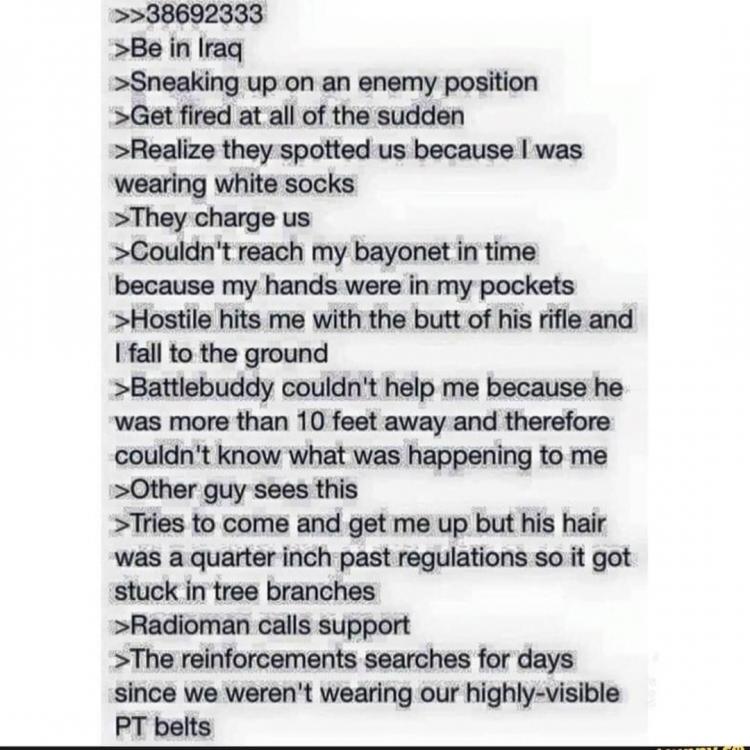
2 pointsChange the narrative a little and it still fits what’s happening in today’s USAF.
 2 points
 -
2 pointsEhhhh, this is what happens when you make exceptions to rules. You get people who play games. Don't give one shit that his beliefs are "sincerely" held - as if it was up to a Chaplain to make that determination in the first place. Also, it's BS that M.E. countries don't have to shave to wear an O2 mask, but I do. But whatever, this is much ado about nothing. Just glad I'm not having to see this paperwork cross my desk. The military is full of arbitrary rules - those are the only ones that should be eligible for "exception." If it's safety, good order/discipline, combat, etc, you follow the rules. No exceptions. Don't like it? Go sit in Leavenworth for the rest of your commitment, your choice. Oh, and the section of the bible that deals with masking and non-masking is right underneath the one that exempts Weapons' officers from SOF...2 points
-
2 pointsThis is the catch 22 right here. You can’t stifle free speech or freedom of the “press” but the more misinformation and misleading clickbait headlines that come through the handheld devices that every idiot is glued to, the worse things get. You know the Chinese and Russians are laughing their asses off.2 points
-
2 pointsI would like to see a meta-analysis of multiple fact checkers too. Like, "our liberal fact checker says its mostly true but our conservative fact checker says its false, and here is a link to their their assessments." Even fact checkers are subject to confirmation bias.2 points
-
2 pointsThose morons can't maintain a treadmill in the gym. As soon as that helo goes Code 3, it will be a static display.2 points
-
2 points
-
2 pointsMight as well switch to Navy Fed for banking. I did four years ago from USAA and Navy Fed is what USAA was 15+ years ago in terms of customer service.2 points
-
1 pointNo, at some point the population needs to take responsibility. A whole generation has been raised under our protection, 20 years to learn to fight and govern themselves. F-ck them. They’ll get used to Taliban rule….again.1 point
-
1 pointWhat would make her look more credible on social media would be to site specifics as to what makes it an "unlawful order". If the DoD can't mandate a vaccine for Active Duty service members that has been approved by the FDA and recommended by the CDC for emergency usage, I question our ability to enforce anything in crisis much more severe than this one. That is a reasonable/rational thought. I like it.1 point
-
1 pointWhat would make her look more credible on social media would be to site specifics as to what makes it an "unlawful order". If the DoD can't mandate a vaccine for Active Duty service members that has been approved by the FDA and recommended by the CDC for emergency usage, I question our ability to enforce anything in crisis much more severe than this one.1 point
-
1 pointI expected it to be another awful inflight movie, but it was great. Had 20 minutes left when I had to deplane. Can’t wait to finish it.1 point
-
1 pointTwo squadron mates just got called within days of submitting their apps to DAL. One was asked if he could be down there 3 business days later. Both had an availability date of November. Put them in and make sure they're polished. Oh and have all your stuff (sealed transcripts, mil records, etc...) ready for the interview as soon as you hit submit. Stuff can happen fast.1 point
-
1 pointWe only half assed it though. I don't think the Taliban can be defeated if we don't snuff the root which is the materiel support they're getting from Pakistan.1 point
-
1 pointThe afghanis deserve to live under the Taliban. 20 yrs of assistance from a superpower and they still can’t stand. F em1 point
-
1 point
-
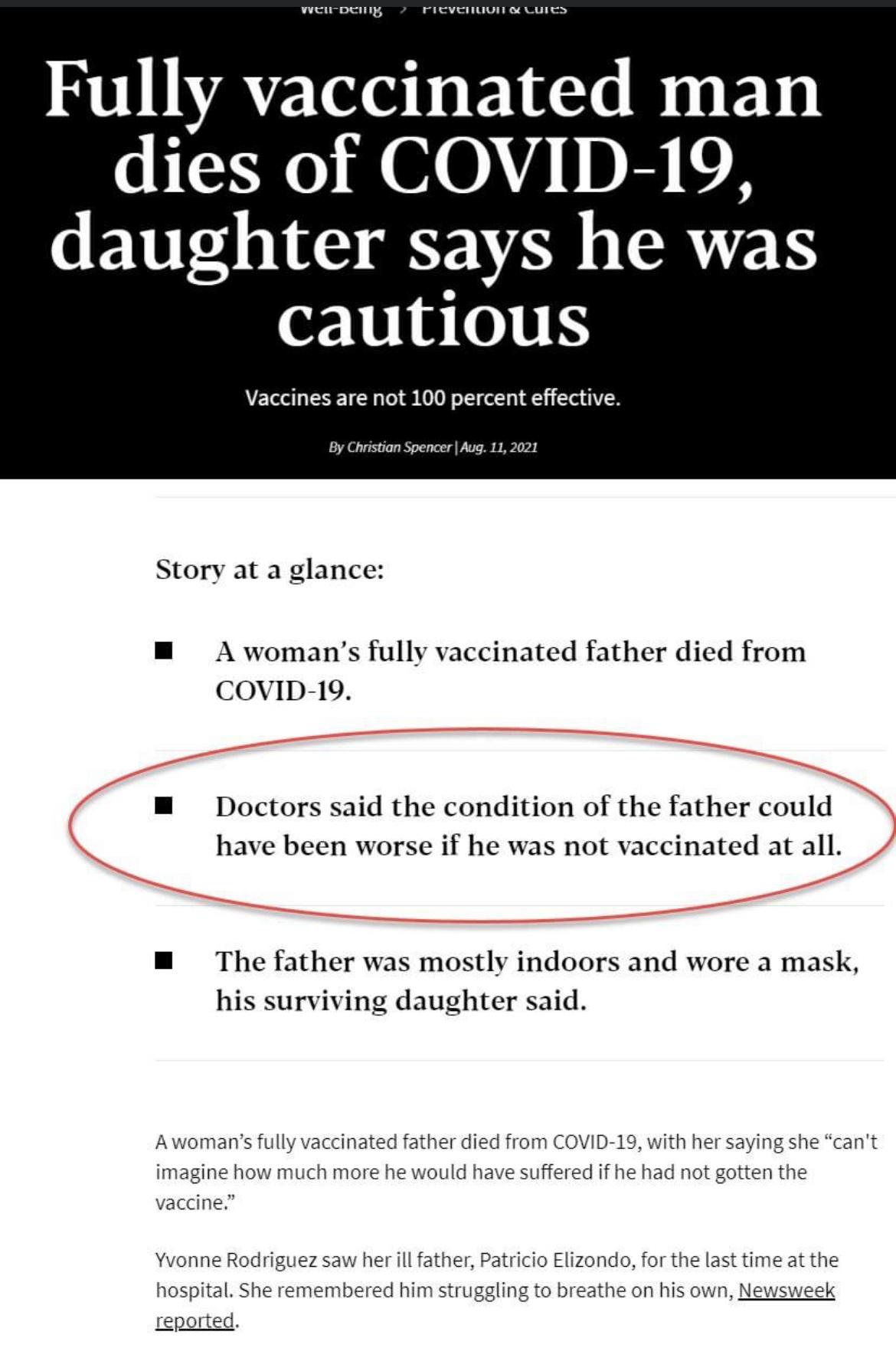
1 pointI got my first jab yesterday at my local Pharmacy. I wanted the Pfizer flavor so I shopped around for one who stocked that one. 16 hours later, I haven't grown an extra testicle yet, so I suppose it's "so-far-so-good". Slightly sore arm... no other side-effects thus far, but I hear it's the 2nd one that gets you. I found a good explanation about the COVID vaccines (cut and paste from an article): Del Rio noted that the vaccines were specifically designed to protect against severe disease and death, and that's what those big vaccine trials looked for. "Infection was never an end-point in these studies," he said. That the vaccines were later found to prevent infection, he said "was a little bit ... like the cherry on the cake." The phrasing also bothers immunologist and virologist Dr. Barney Graham, deputy director of the Vaccine Research Center at the National Institute of Allergy and Infectious Diseases, whose lab played a key role in the development of the Moderna vaccine. Graham described it in a way that really made me visualize the vaccine's effect on your body. "The vaccines were always designed to focus against disease in the lower airways [the lungs] -- not in the upper airways [the nose and upper throat]," he explained. Think about that. According to Graham, a person becomes severely ill when the virus enters the lungs, and that is exactly where the vaccines offer up their most protective barrier. You see, the vaccines trigger the creation of immunoglobulins, which are proteins that function as antibodies. The main one generated by the vaccines is immunoglobulin G (IgG) which easily moves from the blood into the lower airways (the lungs) where it can block the virus. The level of IgG in blood needed to penetrate the tissues of the upper airways (the nose and throat) is much higher and that is why it is more difficult to block the virus from growing in the nose. "That's why we see such consistency in the efficacy against severe disease. It wasn't designed to protect the upper airways as much," he explained. It is also why Graham said scientists weren't expecting the vaccines to prevent infection as much. "We got very lucky that it did to some extent, against earlier strains," he added. And, while the Delta variant is more transmissible, meaning more infections will certainly occur overall in both the vaccinated and unvaccinated, there will be a bigger difference between the two groups when it comes to protection against severe disease compared to protection against mild or asymptomatic illness, Graham explained. That's clear from data that show the overwhelming majority of hospitalizations and deaths happen in the unvaccinated, not the vaccinated.1 point
-
1 pointCool, was wondering what that one was like. I know someone mentioned it wasn’t that great, but I’m more willing to drop 300 cents on it just for some mindless action. Us airline guys get cheap sometimes, just didn’t want to pay $20 on Direct a couple of months ago. Thanks LR! One of my airline buds said The Tomorrow War was very good. I hope it is.1 point
-
1 point
-
1 pointNot to mention the whole thing reads like the wet dream of a Qanon level conspiracy theorist.1 point
-
1 pointNot a spear, but just a general comment to anyone browsing in the future that an annual financial self-examination can be a helpful way to avoid losing out. There are plenty of small charges that creep, and we switched insurance agencies after a similar scenario.1 point
-
1 pointI have to believe that if a general said that to SECDEF, the second half of this article would be about their replacement.1 point
-
1 pointExcept it’s from a bullshit fake news site so there’s that. The sad thing is that people will read that website and believe every word. It almost trapped Tank.1 point
-
1 point
-
1 pointMust be the fluoride in the water that emasculated ‘em. If there’s one thing I can’t stand it’s all these fucking hipster Karen scientists. Amirite?1 point
-
1 pointIt’s a roll of the dice either way right? The average person has no ill effects from the vaccine as well. But how do you know you’re not gonna get the ventilator or the kidney failure? Same way you really don’t know if you’ll get blood clots from the jab. So you research, use critical thinking, numbers and data. Which risk do you consider to be higher. I personally think there will likely be long term health problems (lung, heart, neurological, circulatory issues) for those who have been hospitalized with COVID. We are already seeing “long haulers” and folks who survive and are strapped to an O2 tank. I think that the vaccine (as it should) shows your immune system what to expect so you can fight COVID without the potential of being overrun. A sneak preview if you will. That’s how I ran my ORM sheet. YMMV. This whole thread reminds me of a time where I was in Moron. We had a -135 and a spare -135 with engines running to meet up with a Coronet moving west. Thunderstorms were moving in, they were outside of 5 miles but all around the field. The primary taxied out (new AC at the helm) checked the radar, didn’t feel comfortable, called in and said he was a Wx cnx. The spare (a more seasoned crew) took a sweep with the radar, saw a hole, called and said I think we can go, we see a way to get it done. So they went. Each crew called upon their knowledge, research of the situation, comfort level and made a decision. Is there a wrong answer? Maybe if the jet that went got struck by lightning then yeah. Maybe if it was an OIR mission with troops in contact and they cancelled with no GAR, sure. Nobody questioned either crew and their decisions were exactly 180 out from each other. So is there a wrong answer here? Maybe if you throw a blood clot or have some reaction to the jab. Maybe if you are belly up with 80% o2 or on dialysis for the rest of your days or you lose your Class 1 because you have brain fog. Maybe you get the shot and you’re fine. Maybe you get COVID and you’re fine and now you have better antibodies than the shot can provide. To each their own I guess.1 point
-
1 pointFind out who the contract masters are. They'll be well-known through whatever online forum your pilots use. Read everything they post. Can them with questions. Learn every hustle out there, including the mechanics of how the contract enables the hustle. You want to know every loophole and strategy in depth, *then* decide what type of pilot career you want. I was lucky, my newhire mentor was a union contract compliance volunteer, so I was given a huge head start, but the information is out there. The three primary ways to exploit this knowledge: - Maximize pay (Raw earnings) - Maximize Time Off - Maximize efficiency (pay earned per actual hours flown) I prefer option three. The more flexible you are, the greater you can maximize the option you choose. This summer has been insane for 737 FOs. As a year-four FO I made 31k in May, 23k in June, and 20k in July. Add 16% for the 401k. In those three months I flew a total of about 70 hours, deadheaded for another 30, and went to annual training. That's somewhere around 5 hours of pay for every hour flown. If I chose option 1, I probably could have done ~30k in June and July. Option two is tough when the airline is undermanned. Live near a domicile, don't take the early upgrade, and know your contract. Each of those rules will immeasurably improve your Quality of Life.1 point
-
0 pointsI don't know her, but she sounds like an idiot. It's going to be a tough one for Commanders to explain when even a small percentage of their troops are lying in a hospital bed on a ventilator when they could be performing their jobs.0 points