Leaderboard
-
hockeydork
Super User11Points253Posts -
ViperMan
Supreme User10Points861Posts -
arg
Supreme User7Points1,375Posts -
FLEA
Supreme User4Points2,053Posts


Popular Content
Showing content with the highest reputation on 03/09/2022 in Posts
-
8 pointsIt's not necessarily about punishment per se. Though it will be punishing, to be sure. It has multi-pronged effects that are more important. Namely, no one in Russia will be able to avoid figuring out WTF is going on since their money is now worth less than shit. It will cause their government many problems at home. It will limit the ability of the Russian military to make war, because as we all know, it's not lift and thrust that makes airplanes fly, it's money. It will cause massive rift within the Russian power brokerage. It will amplify distrust of the government. It will sow doubt among those who actually trust Putin. It will diminish their future ability to modernize their war machine. In short, it will do all manner of objectively good things. So yeah, sorry your average Ivan is getting it in the pants, but when you compare that to what's happening to your average Ukrainian, that pain inflicted against the Russian populace is meaningless. Fuck 'em.8 points
-
7 pointsMeh, wanna know whats not funny? Having artillery shells landing in apartment complexes, for no reason, in a country that did jack shit to antagonize its neighbor. Maybe the Russian people need to go drag their government out of the Kremlin, the jig is up. Maybe Alex Ovechkin needs to sack up and say you know what, Putin, playing in the NHL is better than the KHL. I guess the Russian conscripts are innocent, since they got told to go blow shit up and kill people, half of whom probably have no idea why. Ukrainian's are sure as shit innocent, they didn't do anything wrong either. The 14 year old brainwashed jihadi in Afghanistan who picked up an RPG was innocent too. So its either the civilian Russian grandmother who has to choose between continuing to gobble Putin's chode of lies or getting her Visa turned off, or the Ukrainian teacher with two days military training shooting at invading Russians, wondering if he'll make it to the end of the week while his wife and kids flee to Poland. If the Russians starve, its their own damn fault. Better a dead Russian than a dead Ukrainian, that calculus is simple right now. Or we could send Americans to die.7 points
-
7 points
-
3 pointsSo you don't want to commit the military and you don't want sanctions. What's left, some strongly worded letters written to the Russian embassy?3 points
-
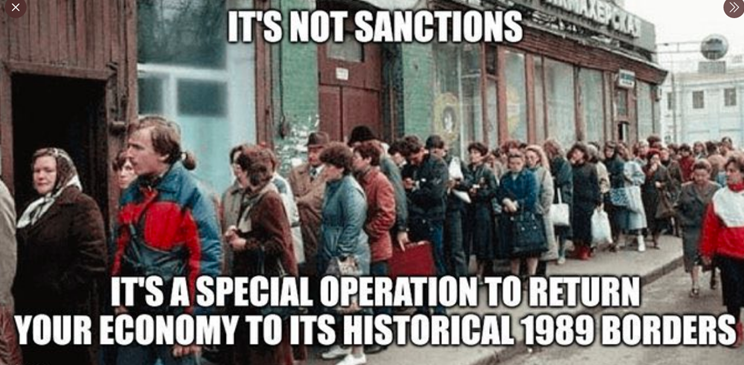
3 points3 points2 pointsThis video is far more than watching a few Russians burn, it represents a paradigm shift in conflict not seen since PGMs in the first Gulf War. Despite S400s and large numbers of Russian tactical SAMs the UAS' have reigned supreme in this conflict. Ukraine's use of the Turkish TB2 has been masterful and well within the S400 ring that is supposed to handle low flying targets like cruise missiles. Additionally, The Ukrainians have used large numbers of smaller systems to scout and provide actionable/targetable intelligence. ISIS and some other folks in the Middle East started the trend, rigging mortars to DJ drones and flying them over allied positions. This video and a host of others out there illustrate how smaller UAS systems can cue Javelin teams and other anti-armor teams and allow them to mass at decisive locations. In effect they have integrated the air land combined arms team at a much lower and highly effective level. It appears the Russians have tried to do the same with far less success. There was report this morning of a Ukrainian woman who knocked out a small Russian drone with...a jar of cucumbers, as it hovered outside her apartment window. I hope those currently serving and our leadership is taking note, I guarantee others are taking learning this lesson and you can bet there will be even more emphasis on counter UAS capabilities.2 points2 points“Working” was defined as causing the populations to rise up. I agree NK is dark at night. Does that mean sanctions are working or does that mean civilians are miserable? I get it. Everyone disagrees with me, and that’s fine. I offer a perspective for consideration so that we think carefully and choose to do things deliberately. Laughing at hungry civilians is for pussies, not warriors.2 points2 pointsIt is different but.....If Putin goes home he's done. He cant just hang a Uey and pretend nothing happened. And then what? You get a global friendly Russia? Or Putin 2.0? I just feel like hes going to double down and go all in.2 points2 pointsHave all the sanctions you want. I love the ones targeting their elite. But celebrating bread lines? Do you think that will make people hate the dictator or hate us? I know it’s an unpopular opinion. But I’m uninterested in hurting civilians. I don’t think it will be effective and I don’t think it’s a good look.2 points2 points2 points2 points2 points1 pointAs @hockeydork said, pumped hydro or spinning the mass in a vacuum are options. I've also been following this company, ENERGY VAULT, (and others like it) and think it could be a potential storage option besides pumped hydro (harder in urban areas) or batteries (high in demand for other uses with currently tight resources/questionable materials availability and practices). I'm no engineering genius, nor, admittedly, have I dug very deep into the technology (it's on the list of things to do), but it kinda makes sense as a simple/viable option that could be deployable in different environments (cities, rural, deserts, limited sun, whatever). Basically, it's a big ass crane that stacks heavy concrete blocks. It can utilize renewable electricity to lift the blocks and store the kinetic energy when power to do so is readily available (when the wind is blowing or the sun is shining), then it can return that kinetic energy to electrical energy by lowering the blocks to turn a generator when other renewables can't (calm days/night). Obviously, baseload potential through (optimally) nuclear or (currently) coal/gas is still a must to ensure there's always something available, but anything that can help defray some of the reliance on fossil fuels/other countries that provide them would be good in my book. Of course, all of these technologies are currently expensive and can't provide what we need at this moment, but we've got to start somewhere. Economies of scale don't just appear, engineering gets better with time, and costs go down/effectiveness goes up when things become more widely implemented, but something has to start the ball rolling. If it's a removal of Russian oil that gets the investment/interest building, so be it. The biggest changes happen when they're affecting wallets, so seems like an opportunity to start that change.1 point1 pointPumped storage has been around for a while, and its only used at small scale to smooth peak loads. It was primarily used as a revenue source over periods between high and low demand and supply constraints...e.g. hot summer days constrained by supply and thermal factors and night time when demand decreased. This works by using excess load during the night to pump water up into a reservoir, then use the same penstock/turbine as a generator system during the day to meet increased load. It basically allowed small generator systems to make revenue by meeting demand during a niche period. After all of the infrastructure costs and efficiency loss in the system, they can squeeze out a small profit during a specific period of time. At scale, this is limited by a number of factors, e.g. geographical location, topography, environmental and hydrological concerns, and system size. I believe the linked video demonstrates the difficulty in achieving any sort of net returns at both small and large scales...there's small "sweet spot" that can smooth demands at local or regional levels. This technology has been around for 100+ years and every so often it gets brought up by alternative energy advocates and activists. Its basically a feel-good story that has numerous constraints that limit its practical application. The same tree huggers calling for alternative energy are going to be pissed when massive areas are cleared for a reservoir and aquatic ecosystems are destroyed.1 point1 pointThe idea of having the majority of our electricity come from solar and wind is untenable. We don't have enough real estate (near places that actually use the power), we don't have enough raw materials, and we don't have even a tenth of a percent of the storage capacity necessary for a couple cloudy weeks of winter. Back it up with nuclear, you say, but if you're going to build nuclear plants that can handle 100% of the electrical load, in addition to renewables that can handle 100% of the electrical load... why not just build the nuclear plants and save literally trillions of dollars (besides letting people virtue signal by having solar roofs). The problem is that the time scale to build a nuclear plant is more or less twenty years at this point. Places that have heavily gone into renewables, like California, are going to face rolling blackouts for at least that long, and that's if their political establishment leans into nuclear today, which it won't. Gas and coal plants are reaching the end of their planned life (if not already years beyond, because replacements won't get permitted), so they'll be offline for maintenance more and more. Meanwhile electricity demands will go up as more EVs hit the roads and natural gas heating is phased out. We really need a national Manhattan Project II to push nuclear, rapidly, around the country, as a matter of national security. As others have said, the sooner oil is only used for niche transport applications and industrial/chemical processes, the better, as we can completely divest from the petrostates abroad.1 point1 pointThe sanctions don't just have the effect of making Russians miserable. The Russian government, unlike the US, doesn't have the luxury of buying weapons on unlimited credit. They need revenue to pay and feed their soldiers, buy new guns, weaponry, etc. Sure, they still have oil revenues, but my guess is that with the sanctions, the Russians sell less gas this year than they did last year, and next year their actual production drops as specialized, irreplaceable equipment and people become scarce.1 point1 pointOk that's cool, we're all working with our own set of terms. Yeah, so they haven't worked according to that metric. That said, sanctions never work overnight, and I think characterizing something that is supposed to work over time as a failure until the moment it works is an unfair judgement to make. I give NK a 0.0% (repeating, of course) chance of being a world-leading nation in the next 100 years under their current regime. Civilians being miserable is a necessary but insufficient condition for sanctions to work in many cases - this one included. And right now, they are acceptable collateral damage. As are their bank accounts, iPhones, and pantries. I quite literally could not care. I hope it motivates them to ask the all-important question: "WTAF?" And finally, anyone's attitude about what is and isn't funny or appropriate is a relative judgement. In light of millions of people being illegally and criminally displaced from their homes and being hungry, yeah, I think that would be a shitty thing to laugh at. Looking at some poor Russian who can no longer get cheese from Italy because his government is *ucked, is funny. And I will laugh at it.1 point1 pointI think there is merit to what you are getting at, which is does punishing a civilian population under the rule of an oppressive regime really have an affect on that regime, because that regime is oppressive and doesn't give a shit about its people to begin with, so it'll just run its own people into misery. That logic checks, but I think that is more applicable in a third world country like NK where the people are (and quite literally) left in the dark. Russia is not that place tho. These citizens have had access to western thoughts. It isn't a place where you are either a peasant or a soldier. They are civilized, and I think there BS meter may be significantly higher. If we do nothing militarily, and nothing economically, you are basically affirming that autocrats can start redrawing borders. The amount of suffering that could come from this in the future is immeasurable. Also the meme is really more of a jab at the Kremlin's justification for invasion, the idea that because "this is how something once was", that's justification to always put it back that way. You were once my wife, but now were divorced, but because you were once my wife I can show up uninvited to dinner with your new husband any time I like. Nobody wins in war, lives are destroyed on both sides forever. None of this is "funny", literally zero. But if you live the holier than thou life tho and have never laughed at any dark humor good for you, and that is an earnest even tho you just called me a P*ssy.1 point1 pointHmmm, lemme check. Ghadafi? Dead. Saddam? Dead. Slobodan Milosevic? Dead. So yeah, maybe sanctions don't "work", but if I was a dictator, it would seem to me that sanctions are a pit stop that the West puts me in for a few months or years before I wind up getting killed by someone they support. And to your comment that it's not working in Iran or NK, I will disagree by simply saying you're wrong - without evidence - because I can. Look at a map of SK vs NK when they're lit at night...I'd say they're working.1 point1 pointOk, Ill explain nK because I know this one a lot better. I've also realized a lot of confusion on what sanctions are, how they are enforced, and what we can and cant do with them. Im by no means an expert but I do have a decent grasp on some of this. Sanctions can generally be unilateral, or cooperative. The strongest sanctions are cooperative sanctions backed by a UNSCR. This is the case of nK. The reason the UNSCR is important is because it gives the UN the authority to appoint a military commander to enforce the sanctions using military force. In the case of nK, the USINDOPACOM commander is the UNSCR commander and is authorized under the UN to enforce maritime trade against nK. North Korea, operates a rice economy. In short, farm crops are traded for commodities more routinely than fiat currency. Under KJI, there was a massive military buildup through the 90s until his death. Specific of note he passed an ordinance through the party cabinet that allowed military commanders the authority to sequester a farmer's crops to feed their battalion. The problem is, this led to corruption, because more often than not, commanders were taking the crops to use as currency and not to feed the battalion. Obviously this caused a lot of starvation. When KJU came to power, there were questions about his legitimacy, as it is with any ascension to power in a monarchy (or dictatorship, its not clear what nK is right now). This led KJU to consolidate power by purging but he also realized his father was deeply unpopular with the military and with the working class due to the mass hunger. So KJU led a massive expansion of internal economic expansion and gutted the military. The ONLY military capital he continued growth investment in was his nuclear and SOF forces. This was because DPRK probably assessed they can no longer win a conventional war against sK, even without US support. Therefore, asymmetric capabilities as deterrence became their only option. To fuel this growth faster, KJU sought to bring an end to to the war by finally signing peace accords and permanently ending the UN mission to the Korean peninsula. (Different UN mission, this is the 1950's UN mission to maintain the armistice) This would have had major geopolitical effects on the peninsula, but in short he assessed he could further divest his military into the economy if he needed to. And its what brought nK to the talking table, in and of itself a major step. The reason the peace talks failed is because nK was insistent that they maintain some nuclear capability because it was their country's only form of defense after gutting their forces. However, this is basically a red line for the US because as one of five benefactors of the NPT, we do not what other country's having nukes. We also we uncertain what allowing nK to continue to hold nuclear weapons would mean for other NPT signers who were not party to the talks. That said, there is still hope. nK has temporarily withdrawn but their internal economic policies seem to still be in place. Iran is a bit of a different story and I'm less smart on it. Iran was cooperative sanctions that were not backed by a UNSCR. So we relied on the participation of Germany, France the UK and a few other European traders to enforce the sanctions. This arrangement did work and also brought Iran to the talking table. Whether the agreement was good or not is immaterial now because it was simply the best agreement we were going to get. Withdrawing, in my opinion, was a massive mistake. The reason is because Europe largely supported the agreement and they were reluctant partners on the sanctions to begin with. So when we withdrew, the sanctions became unilateral and became near useless. Because of that, when we returned during this administration to the talking table, our bargaining leverage was extremely low. It is being reported by media that Iran is likely going to get away with a steal in this next agreement. I would say its shortsighted to say Iran didn't go our way though because it did go our way and then we withdrew from it.1 point1 pointAlso, noble indeed, but its not fair for you to feel like you have to carry the burden of somebody else's poor decisions. If you were commanding a nuclear sub and got word DC just got nuked by the Russians, are you going to not nuke Moscow because of the innocent civilians who literally had nothing to do with it? Putin knew that the global response to this was possibly going to be crippling sanctions against his country. He and his enablers did it anyways. Don't carry his bad karma baggage for him. Last thing we need is for people in the west to start feeling bad for him and like they're responsible somehow for all of this.1 point1 pointMight not make them love us, but it also might make them start asking questions about what they’re seeing on state TV and why the rest of the world is reacting so harshly. I don’t think the idea is to starve the Russian people. I do think the idea is to squeeze Putin at every possible pressure point.1 point1 pointI'm really hoping the planes are already in Ukraine flying missions and we're just pretending we can't figure out how to get them there. It would avoid escalation but still help the Ukrainians; plus I think we could get away with it. We've already seen the Russians attacking deserted Ukrainian bases and wasting missiles on places where IADS used to be weeks ago.. so there's clearly a weak spot in Russian real time Intel gathering. I know global geopolitics is incredibly difficult, but i also know there is a lot of really smart diplomats and strategists on our side. I choose to believe the west is the one playing 4D chess here.1 point1 pointClown show going on between various governments in NATO but not invoking NATO regarding sliding the Ukrainians some MiG-29s. Poland: We'll give you MiGs, send 'em to Ramstein, the Ukrainians pick 'em up. In return, you give us used F-16s. DC: Wha???!!! On a serious note, if this is some sort of a thing, where would the MiGs be based? Inside Ukraine and they are insta-HVAs for the Russians. Outside Ukraine and the host nation just joined the war. So, either a clownshow or some psyop thing that, again, I'm not smart enough to deciper.1 point1 pointThats fair and a criticism of any poll. But there is only so much you can do to eliminate selection bias. No polling is perfect, just ask Hilary!1 point1 pointThey have a full population sample up to 65+. Where do you see it focused on college students? A university poll means it was conducted by a university, doesn't mean it just poll'd university students. From the study "The Quinnipiac University Poll, directed by Doug Schwartz, Ph.D. since 1994, conducts independent, non-partisan national and state polls on politics and issues. Surveys adhere to industry best practices and are based on random samples of adults using random digit dialing with live interviewers calling landlines and cell phones." "1,374 U.S. adults nationwide were surveyed from March 4th – 6 th with a margin of error of +/- 2.6 percentage points."1 point1 pointWell its not a military effect for one. Its an economic effect and economic power is exercised very differently. I agree that chuckling at hunger is not apropo. That said, there is some rationale here. For one, just scratching the surface, tightening Russia's economy reduces revenue available to their war machine. It will make it difficult for them to sustain an extended campaign. Putin will have to choose to feed his people or expand his military efforts. I know the knee jerk thought is he wouldn't do that, but remember Machiavelli here, the primary security concern of the Prince is to prevent rebellion, not external security. We've seen dictators practice this time and time before. Kim Jong Un is a good example who didn't have the popularity of his father when he ascended and immediately needed to reinvest military capital into the country's agricultural sector to balance his internal/external affairs.1 point1 pointFull disclosure, I know him in the real world and he is a good human being. While I have no desire to sit around the camp fire in my hemp pants eating veggie meat while we play the tambourine, he is an American patriot and a warrior and I would proudly serve with him.1 point1 pointOps tested Feb 2021 in TX. Wind and solar make great supplementals, not the main mast of the ship.1 point1 pointUSAA took another step backward today as they are eliminating the Limitless 2.5% cash back credit card. Replacing it will be a Preferred Cash Rewards Visa paying 1.5% cash back. USAA is slowly turning into any run of the mill bank.1 point1 point1 pointUnconfirmed reports coming out on Twitter night now saying a Ukrainian Marine unit conducted a raid on Kherson airfield and destroyed around 30 forward deployed Russian helicopters. Here’s to hoping it’s true.1 point1 pointLess walls of text more pics of hot eastern european chicks please1 point1 pointWe could just tell Saudi to pump more or we’ll pull everyone out and they can deal with Iran.1 point-1 pointsDidnt Iraq have sanctions in the 90's that the UN estimated was responsible for over 500k dead mostly children? You think in WW2 the allies wanted unconditional surrender. That made the Germans and Japanese only fight on harder. More people died in the last year of hte war than all the previous combined. I dont know what the solution is but backing Putin in a corner could be dangerous. If he loses in Ukraine more of Russia will break away and he will lose more resources. Mostly the oil around the Caspian Sea which is vast. He will lose out on the revenue from transportation of crude as well. Even China could become aggressive in Russia's east. They can be starved out through sanctions but I think that will only draw more internal support for Putin. Putin can also show his neighbors that if you go against him he will exhaust all resources to burn you down like Ukraine. Maybe that is his path to victory and create a new economic zone with his neighboring allies and China? If he can take Ukraine he will have a stable food source and can influence the global food market. Also, I guess we're buying Crude from Venezuela now...Good job Brandon!-1 points-1 pointsSorry, screw them. They made their bed by supporting Putin all these years. Sent from my iPhone using Tapatalk-1 points-3 pointsI think it’s a terrible idea to hurt Russia’s economy and their people just because we don’t like what Putin is doing. Mass punishment doesn’t work on me or you or anyone. Human beings hate that shit. i’m not sure what specific military effect we want to achieve by turning off some grandmother‘s credit card, or what we expect Russian civilians to do, but I’m not going to chuckle at starving civilians standing in food lines. They are innocent.-3 points